
Line 10100 vs Line 15000 on Your CRA Tax Return
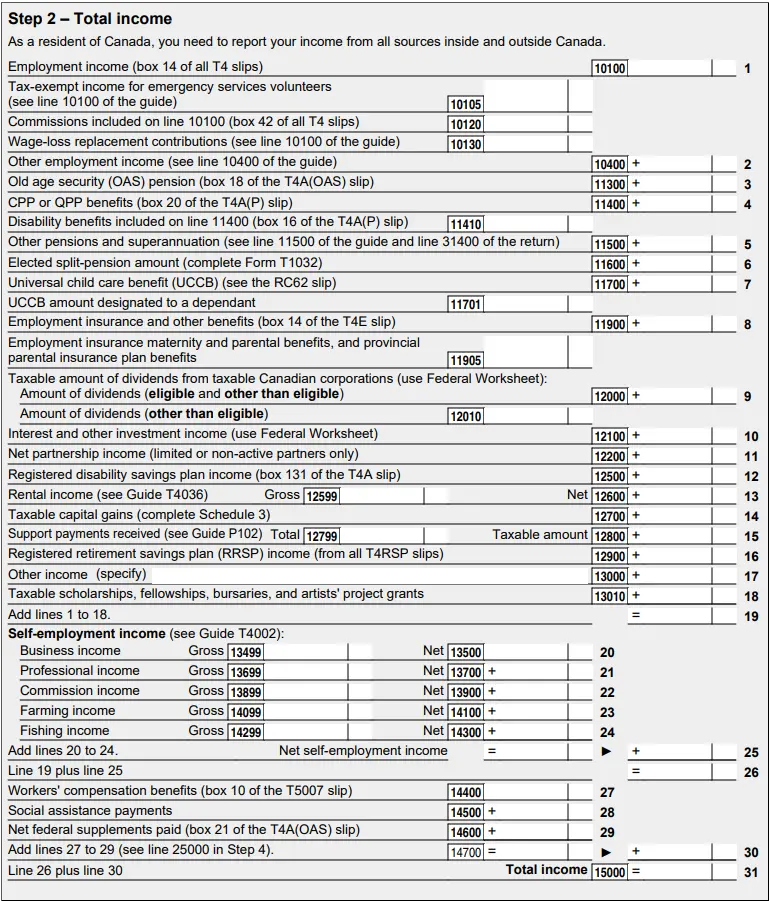
Line 10100 and Line 15000 are two important lines on your CRA tax return, but they are not the same thing. Line 10100 shows only your employment income, the amount reported in Box 14 of your T4 slip. Line 15000 shows your total income from every source you earned money from during the tax year. If employment is your only source of income, these two numbers will look similar. But if you earn rental income, dividends, or pension payments, Line 15000 will be noticeably higher.
Understanding Line 10100 vs Line 15000 is important because both numbers directly affect your tax return, your benefit eligibility, and the credits you are able to claim.
What Is Line 10100 on Your Tax Return?
Line 10100 represents your employment income for the tax year. This number comes directly from Box 14 of your T4 slip, which your employer issues at the end of the year. It includes your regular wages and salary, bonuses, commissions, tips, and any taxable benefits your employer added to your pay. If you worked for more than one employer during the year, you simply add the Box 14 amounts from all your T4 slips together. This combined total is what goes on Line 10100 of your T1 General tax return.
Line 10100 is strictly for employment income and nothing else. It does not include money earned from a rental property, from investments, or from running your own business. It also does not include government payments like Employment Insurance or Canada Pension Plan benefits. Many people assume all income reported on a T slip goes to Line 10100, but that is not correct.
One thing that catches many people off guard is that Line 10100 does not reflect your take-home pay. It shows your gross employment income before any deductions like income tax, CPP contributions, or EI premiums were taken off. Those deductions are reported elsewhere on your return and may actually result in a refund at tax time. If you are unsure how EI payments are treated on your return, our blog on how much employment insurance in Canada explains how EI benefits are reported and how they factor into your overall tax picture.
What Is Line 15000 on Your Tax Return?
Line 15000 is your total income line, and it is the sum of every income source you received during the tax year. It starts with your employment income from Line 10100 and then adds all other income streams on top. This includes self-employment income, rental income, pension income, Old Age Security, Canada Pension Plan benefits, Employment Insurance, investment income, and any other amounts the CRA requires you to report. Every dollar of income you earned during the year eventually makes its way to Line 15000.
Line 15000 is also called total income before adjustments. After this line, you can apply certain deductions to reduce your income and lower your tax bill. These deductions include RRSP contributions, union dues, child care expenses, and moving expenses among others. Once those deductions are subtracted, you arrive at your net income on Line 23600.
Many government benefits in Canada are directly based on the income reported at Line 15000. The GST/HST credit, the Canada Child Benefit, and even the Canada Workers Benefit payment dates and payment amounts are all calculated using your family net income, which starts at Line 15000. If you are a non-resident earning Canadian income, this line is also central to how your taxes are assessed by the CRA. Our blog on non-residents with Canadian rental income covers how rental and other income is properly reported for non-residents filing a Canadian tax return.
Line 10100 vs Line 15000: Side-by-Side Comparison
The table below breaks down the key differences between Line 10100 and Line 15000 in a simple and clear format so you can see exactly how these two lines compare against each other.
| Feature | Line 10100 | Line 15000 |
|---|---|---|
| What it represents | Employment income only | Total income from all sources |
| Source document | T4 slip Box 14 | Multiple slips and schedules |
| Includes rental income | No | Yes |
| Includes investment income | No | Yes |
| Includes self-employment income | No | Yes |
| Includes EI and CPP benefits | No | Yes |
| Used for benefits calculation | Indirectly | Yes, directly |
| Affects RRSP contribution room | Yes, as earned income | Yes, as starting point |
| Position on T1 return | Early in income section | After all income lines totaled |
| Also known as | Employment income line | Total income before adjustments |
Why Line 15000 Matters More Than You Think?
Line 15000 is one of the most referenced numbers on your entire tax return. The CRA uses this figure as a starting point to calculate your net income, which then determines your eligibility for a wide range of government benefits and tax credits. The GST/HST credit is one clear example where your family net income plays a direct role in both eligibility and the amount you receive. Our blog on GST credit payment dates explains how this credit is calculated and when payments are issued throughout the year.
Line 15000 also affects how much RRSP contribution room you build up each year. Your RRSP limit is calculated based on your earned income from the previous year, and a large portion of that earned income comes from what is reported on Line 10100. The higher your earned income, the more room you have to contribute to your RRSP the following tax year. Making full use of your RRSP contribution room is one of the most effective ways to reduce your taxable income, and this fits directly into a smart year end tax planning strategy that every Calgary taxpayer should consider.
For Calgary residents managing more than one income source, keeping Line 15000 as accurate and optimized as possible is very important. Calgary Tax Consulting provides Personal Income Tax returns in Calgary, Calgary Tax Review, Year End Tax Planning, and Financial Statements services in Calgary to help you file accurately and take full advantage of every deduction and credit available to you. Getting professional help means you are not leaving money on the table, and both Line 10100 and Line 15000 on your return reflect the correct and complete picture of your income every single year.
How These Lines Affect Your Tax Deductions and Credits?
Line 10100 plays a direct role in determining certain employment-related deductions you can claim on your return. For example, union dues and professional membership fees are tied to your employment income. Home office expenses and vehicle expenses used for work are also connected to what you reported on Line 10100. Getting this line right from the very start ensures that all related deductions are correctly calculated and that you are not missing out on amounts you are fully entitled to claim.
Line 15000, on the other hand, opens the door to a broader set of deductions and credits that apply across all income types. RRSP contributions, deductible child care expenses, and moving expenses are all subtracted from your total income at Line 15000 to arrive at your net income. Our blog on child care expenses in Calgary is a helpful resource if you want to understand exactly what qualifies as a deductible child care cost and how to claim it correctly on your return.
Investment income such as dividends and interest is reported through T5 slips and feeds directly into Line 15000. If you are not familiar with T5 slips, our blog on what is a T5 slip in Canada explains what income is captured on this slip and where it belongs on your return. If you are also a business owner or self-employed individual, your business income also contributes to Line 15000.
Common Mistakes to Avoid When Reporting These Lines
Getting Line 10100 and Line 15000 right matters more than most people realize. Here are the most common mistakes Calgary taxpayers make when filing:
- Reporting rental or side income on Line 10100 instead of its correct line, which inflates your employment income and misrepresents your tax situation
- Leaving out income sources from Line 15000 such as investment dividends, EI payments, or pension income, which results in an incomplete and inaccurate return
- Confusing gross employment income with net pay, since Line 10100 reflects your gross income before deductions, not what actually hit your bank account
- Forgetting to add T4 slips from multiple employers when you worked more than one job, which leads to an understated Line 10100
- Not reporting T5 investment income, which belongs in Line 15000, often because people assume only T4 income needs to be reported
- Mixing up Line 15000 and Line 23600, since Line 15000 is total income before deductions, while Line 23600 is your net income after deductions and the two are very different numbers
- Skipping a proper bookkeeping record throughout the year, which makes it hard to track all income sources accurately come tax season, our blog on the bookkeeping checklist for small business can help you stay organized all year long
Frequently Asked Questions
Q. What is the difference between Line 10100 and Line 15000 on a CRA tax return?
Line 10100 is your employment income only from your T4 slip, while Line 15000 is your total income from all sources including rental, investment, pension, and government benefits combined.
Q. Can Line 10100 and Line 15000 show the same amount?
Yes, if your only source of income is employment, both lines will show the same or a very similar amount on your T1 General return.
Q. Does Line 10100 include tips and commissions?
Yes, tips, commissions, and bonuses from your employer are included in Line 10100 as long as they are reported in Box 14 of your T4 slip.
Q. Why does Line 15000 matter for government benefits in Canada?
Many benefits like the GST/HST credit and the Canada Child Benefit are calculated based on net income, which is derived directly from your Line 15000 total income figure.
Q. What happens if I report the wrong amount on Line 15000?
An incorrect Line 15000 can lead to a CRA reassessment, missed credits, overbilling, or even penalties depending on the nature of the error, so accuracy is essential.